
EMPLOYEE INTERVIEWS

Programmer

A Graphics Programmer finding a path to more natural visuals

Joined in 2023

Programmer K.Y.

\ Career Path /

Studied graphics technologies for game engines at a vocational school.
Aspired to join SEGA because of its proprietary engines and appealing IPs.
First assignment after joining SEGA was tuning an automated gameplay testing system.
Worked on graphics programming.
Focused on enhancing visual quality through the implementation and improvement of weather systems and visual effects.
01STEP 1
02STEP 2
03STEP 3

Q1
What I Studied

I developed my own game engine as part of the curriculum at my vocational school. After learning the fundamentals, I focused my research on in-engine graphics technologies capable of achieving higher-quality visuals. I also enjoy working with people, so I had a part-time job at a restaurant where I cooked and handled customer service. Through that experience, cooking became a hobby of mine, and I still make my own meals almost every day.

Q2
Why I Joined SEGA

I was drawn to SEGA by its commitment to pursuing realistic visuals through its proprietary game engines, and by its portfolio of compelling IPs, including the Like a Dragon & Yakuza Series. What ultimately convinced me was that, even when I was considering withdrawing from the hiring process, SEGA still gave me the opportunity to attend a final interview and tour the company. The support I received throughout the hiring process helped me envision what it would be like to work at SEGA and showed me it's a company that truly values its people.

Q3
My First Assignments at SEGA

Shortly after joining the team, I was responsible for creating data for an automated testing system that plays the game, detects issues, and generates reports. The system records gameplay actions as someone plays through minigames and side quests, then uses that data to automatically reproduce those actions. I was surprised to learn that, including the engine development team, only around 20 to 30 programmers worked on the Like a Dragon & Yakuza Series and still managed to deliver a new title every year.
Q4
Biggest Surprise After Joining SEGA

Before joining the company, I thought that a large organization would probably have a culture of seniority and a tendency for managers' opinions to carry the most weight. In reality, however, I found myself surrounded by creators who freely exchanged ideas, regardless of title or seniority, all with the shared goal of making better games. Even when a proposal comes from a new employee, it isn't rejected out of hand. Colleagues take the time to consider how that proposal could be made even better. Another pleasant surprise was how approachable managers are—both in terms of physical distance and attitude. There's an open culture that makes it easy to ask for advice and discuss ideas.
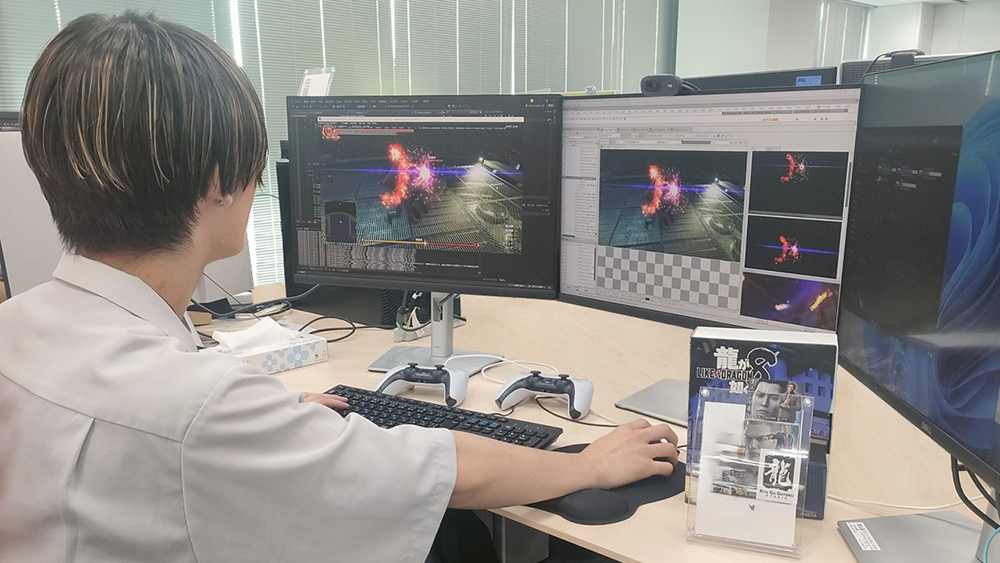
Checking the visual effects for the final battle during development of Yakuza Kiwami 3 & Dark Ties

Q5
Current Duties

I currently work on graphics programming for the Like a Dragon & Yakuza Series. My main responsibilities include programming and managing weather-related effects, such as rain, along with effects that dynamically respond to the movements of characters and vehicles. For example, in Like a Dragon: Pirate Yakuza in Hawaii, I implemented effects that change based on the situation, such as dynamically adjusting the amount of spray based on a ship's speed and where it contacts the water. I'm also involved in evaluating new technologies and updating engine features.


Q6
Motivation and Successes

One of the most rewarding aspects of my work is turning artists' ideas into reality and enabling visual expressions that were previously hard to achieve. For Like a Dragon: Pirate Yakuza in Hawaii, I tackled the challenge of building a system where rain, fog, clouds, and ocean visuals transitioned naturally between different sea regions. To me, background graphics are successful when they blend naturally into the scene—when players don't even notice them. It was incredibly satisfying to come across reactions on social media from players who saw the small details we had paid special attention to during development.

Q7
Future Goals

I want to continue exploring graphics technologies and improving our engines to create even richer visuals. I'm also part of the team that trains new hires, sharing knowledge of the Dragon Engine and other game engines. I hope to further refine not only my technical knowledge, but also my ability to communicate that knowledge in a way that's easy for others to understand. My long-term goal is to continue working as a programmer while taking on a leadership role, helping both my colleagues and the organization grow.

Q8
SEGA's Appeal

The open culture here makes it easy to seek out advice and exchange ideas. Because managers, artists, designers, and programmers work on the same floor, it's easy to discuss ideas in person as well as over chat. I also like that initiative and results are properly recognized and rewarded. I feel that SEGA has an environment where it's easy to deliver results at your own pace. We buckle down during busy periods and head home earlier when things are less hectic.

Q9
Message to Applicants

I love working with people who go beyond the basic requirements and constantly look for ways to improve the player experience. A lot of different forms of visual expression and gameplay systems can only be realized through a programmer's eyes. I believe that anyone who is enthusiastic about pursuing their own ideas and techniques will fully enjoy the unique rewards of making games here at SEGA.

Q10
A Recent Highlight

One of my recent highlights was trying burdock tempura udon during a trip to Hakata. The broth had a deep, savory flavor that was a perfect match for the soft and silky udon noodles. Since we're able to take longer vacations between major project milestones, I enjoy traveling and discovering new local cuisine. I look forward to it as a reward for my hard work.

A Typical Day

10:15 AM 
Arrive at the office
10:30 AM 
Team meeting to check task progress
Review high-priority tasks, discuss issues
11:00 AM 
Implementation and improvement of graphics features
12:30 PM 
Lunch Break
1:30 PM 
Work with artists to evaluate new visual ideas and user-friendly tools
2:00 PM 
Project meeting
Review specifications and proposed ideas for new visual features
3:00 PM 
Work with artists and designers to implement and fine-tune features
5:00 PM 
Project meeting
Share technical knowledge and discuss challenges with members of other projects
6:00 PM 
Implement and test features based on meeting discussions
Handle urgent fixes
8:00 PM 
Leave the office
[an error occurred while processing this directive]